
This match review is freely available to read in full. If you’d like to access content like this after every single West Ham match, sign up and become an Analytics United member today.
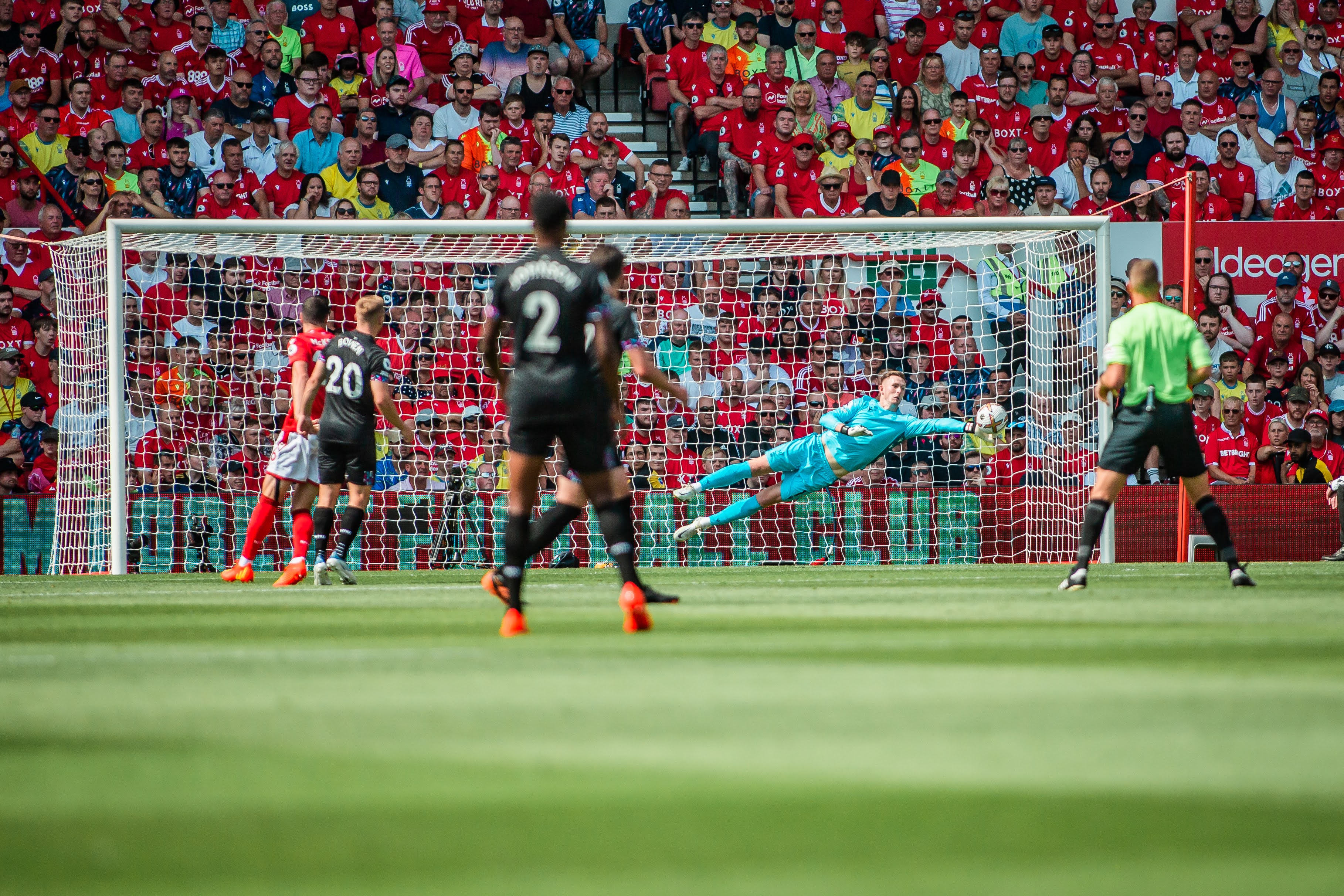
With a hefty slice of good fortune mixed in with an incredible team effort and performance, Nottingham Forest managed to secure a 1-0 victory over West Ham in their first home match in the top flight since 1999 on Sunday. David Moyes’ men were unlucky to be on the losing side after hitting the bar twice, failing to score a penalty, seeing a goal disallowed and having two efforts cleared off the line but Forest deserve huge credit for their impressive last-ditch defending throughout.
If there was one key thing that West Ham didn’t get right in this game, it was matching Forest’s intensity in the opening period and killing the tempo. With the home fans generating a great atmosphere to herald the Reds’ return to the Premier League, Steve Cooper’s side came flying out of the traps and dominated the opening exchanges, winning every duel and being first to every loose ball. The pressure initiated by the brand new midfield partnership of Lewis O’Brien and Orel Mangala was relentless and Forest recorded a stunningly low PPDA of just 4.2 in the opening 15 minutes.

In this opening period, West Ham’s team average pass accuracy was just 60% – a clear indication of the pressure exerted by Forest unsettling Moyes’ team and creating the kind of chaotic conditions in which a transition-focused side can thrive. In many ways, Forest were doing exactly what West Ham did in the 2020-21 season with a back three behind an aggressive midfield partnership forcing chaos for the likes of Taiwo Awoniyi to thrive.
It’s unsurpsising to see Awoniyi performing so well in such a system, we recommended him as a long-term Michail Antonio replacement back in January. And it was his link-up play with Brennan Johnson and Jesse Lingard that caused all kinds of issues for the West Ham defence at the beginning of the match.
As Carlon Carpenter pointed out on Twitter, Forest did an excellent job of vacating the midfield to bait pressure before playing direct balls into Awoniyi while keeping Johnson and Lingard in close proximity to the striker to ensure numerical superiority as the ball drops.


West Ham struggled to get to grips with this early in the match as Declan Rice in particular found it difficult to cope in a lone-six role that he hasn’t played all that often in recent times. Usually we see Souček partnering Rice in a 4231 shape but in this match the midfield three was inverted to allow the full-backs and Souček to get further forward.

Although Rice initially struggled in this shape, when West Ham eventually took more control of the match after the 20th minute, we began to immediately see the benefits of the change in system. With Rice able to operate alone in central areas during build-up, there were far more avenues for central progression than there usually are when Souček is sat alongside him.


This completely contrasts to the woodenness with which West Ham have built up play and progressed the ball in their usual 4231 shape where Souček; who is far less secure, comfortable under pressure and capable of playing progressively; is often left alone in the centre of the pitch while Rice retreats to widen the base and provide escape routes from opposition pressure.

This adjustment of the roles was reflected strongly in the numbers too. Souček’s passing accuracy increased from 70% to 87.5% – the highest of any player on the pitch – while his touches in the attacking third ticked up from an average of 11.2 last season to 15 on Sunday. He was also the target of far fewer direct balls and contested just one aerial duel in the middle third (which he won), four fewer than his average of five last season. Perhaps most significantly, where West Ham really struggled to create chances for Souček last season as attacking responsibilities were more balanced between him and Rice, the Czech midfielder recorded 0.7 xG against Forest. In the 2020-21 season, Souček managed to hit this total in one match on five separate occasions but last season that decreased to just one instance – incidentally another match where Moyes gave Souček more license to attack in a 343 shape rather than the standard 4231.
Although Souček failed to convert any of his three excellent opportunities on Sunday – thanks in part to goalline heroics from Dean Henderson and Harry Toffolo – his performance was much closer in style to the kind that had Premier League fans raving about him just a couple of seasons ago. This could suggest that he may have much more utility going forward if Moyes and West Ham make this tactical tweak a more permanent alteration.
Rice’s total progressive passing distance also increased from his average of 262 yards per 90 last season to 285 on Sunday. And if Rice can develop greater comfortability in this role, we can hope to see that number increase even more. With Fornals balancing the unit and contributing a newfound calmness in possession, his excellent eye for a pass, and his singular ability (within the squad) to spring counter-attacks, the midfield functioned well to transition the ball into the final third and generate opportunities – something we’ve scarcely said about West Ham midfields in recent times.
With the wingers able to start higher and receive earlier, one player in particular benefited greatly. Putting in one of his best ever performances in a West Ham shirt, Saïd Benrahma thrived off the left flank with more space to operate in and with an overlapping threat from left-back generating opportunities to cut inside. For the first time in a long while, we were able to see Benrahma varying his approach and threatening both on the inside and on the outside with his left foot. He was unfortunate to see his goal ruled out after receiving a clever Fornals pass, brushing Lingard aside, nutmegging O’Brien, exchanging passes with Rice and slotting into the corner.
This brings us to the other thing that West Ham struggled with on Sunday. When faced with adversity, alongside Forest’s intensity recovering as the crowd grew louder, Moyes’ players allowed themselves to be rushed and lost control of periods of the match. Forest scythed forwards repeatedly after the disallowed goal and scored the incredibly soft winner as Toffolo drove in off the flank to set-up Lingard – only for the ball to cannon off Johnson onto Awoniyi and into the back of the net.
Moyes said afterwards that the goal was “rotten to the core” and he will be hugely disappointed with how easily his players wilted when things got tough on Sunday. A similar pattern followed both Johnson’s disallowed goal and the penalty miss in the second half after periods in which his side had dominated. But Moyes potentially overreacted in the end as well in subbing Fornals and Antonio in the 68th minute when they were two of West Ham’s better players on the day.
These substitutions were particularly strange given that the manager had actually started preparing Manuel Lanzini and Gianluca Scamacca ten minutes before they eventually came on. And when they did, all of the fluency that West Ham had previously been exhibiting in possession dissipated, with Lanzini unable to replicate the energy and incisiveness produced by Fornals and Scamacca unable to unsettle the Forest defence in quite the same way that Antonio had. Why substitute two of your stronger players when your right winger is having a bit of a disaster?
It’s been a strange start to the campaign for Jarrod Bowen with two sluggish performances so far from West Ham’s top scorer last season. In the first half, Bowen genuinely undermined an otherwise well-oiled attacking unit with his lack of movement and quality on the ball. But he did improve in the second half after discovering that he could drag Scott McKenna out and create space for others thanks to Forest’s man-to-man defensive system.

It’s vital that West Ham resolve the right-side dysfunction that has limited the strength of these opening two performances. Vladimír Coufal found himself in advanced positions a number of times on Sunday but continuously failed to supply quality and recorded just one successful cross from six attempts. His state of complete confusion when dribbling unopposed towards the penalty area in the first half before firing a woeful shot miles wide summed up the lack of composure that has dogged his performances for some time now. His passing accuracy was poor once again (63.8%) and with Bowen recording just 63% success ahead of him and Souček not particularly useful in progressing the ball, that flank is seriously lacking quality when it comes to contributing in general possession.
It seems that West Ham are intent on trying to resolve this by recruiting a central midfielder to rotate with Souček but it wouldn’t be hugely surprising to see right-back become a priority position for recruitment in January if Coufal’s level of performance doesn’t improve.
If there’s a key takeaway from this game it’s that, although the result was disappointing, the performance contained lots of positives to build on. Crudely resimulating the match using the xG data and Danny Page’s match simulator, West Ham won the match 59% of the time and at least drew 22% of the time – meaning that a Forest win only occured in 18% of simulations. With the defensive issues hopefully on their way to being fixed by the addition of new recruit Thilo Kehrer, West Ham need to move on quickly from this result and end their Brighton hoodoo this weekend.
Read Jack’s player ratings here.
